
Inflammation can be a good thing.
When the human body is exposed to injury or infection, inflammation - which can result in redness, heat, swelling and pain as white blood cells fight threats - is the first line of defense. Inflammation helps fight bacteria, viruses and other pathogens and repair damaged tissue.
However, inflammation can become chronic, leading to life-threatening diseases, such as autoimmune and autoinflammatory disorders. Scientists do not fully understand how inflammation becomes unstable.
UC Merced bioengineering Professor Eva de Alba has secured a $3.2 million grant from the National Institutes of Health to clear up that mystery.
"Our laboratory investigates the structure and function of proteins involved in the formation of large multiprotein complexes known as inflammasomes," she said. "These complexes are formed in innate immune cells upon detecting danger signals from pathogens or cell dysfunction and trigger inflammation."
The five-year grant from the NIH will fund research into identifying molecular factors that regulate inflammasome formation and activity.
"Based on these studies, we will develop molecules that inhibit inflammasomes and can be used as scaffolds in drug design," de Alba said. "We will build biomaterials to serve as inflammasome models to facilitate inflammasome research."
The project has the potential to identify new ways of managing chronic inflammation, which can cause fatigue and pain and, if left untreated, can develop into long-term medical conditions, including cardiovascular disease and rheumatoid arthritis.
NIH R01 awards, as they are called, are highly competitive and considered a sign of excellence in biomedical research.
"I feel proud of my lab and myself for all the work we have done that has led us to this point," de Alba said. "I am supported by a wonderful team of researchers who are in the trenches of this research and dedicate their time, effort, commitment and motivation daily."
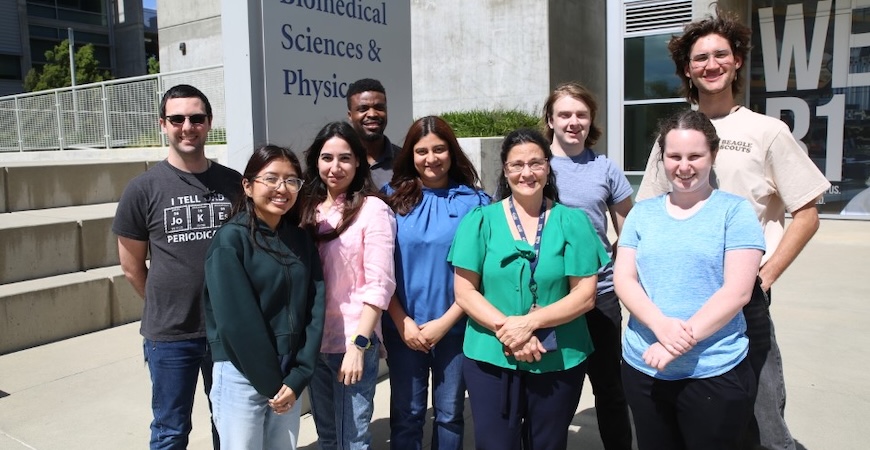
Contributors on de Alba's team include graduate students Sneha Bhat, Ayomide Adeoye and Seth Durrant; postdoctoral scholar researchers Meenakshi Sharma and Christopher Randolph; and undergraduate students Brenna Birnbaum and Joshua Thomas.
"I am also proud to have brought this award to the School of Engineering and the Department of Bioengineering as a way of giving back the support I have received from the School," de Alba said, citing former Dean Mark Matsumoto, current Dean Rakesh Goel, and department chairs Professor Tom Peterson and Professor Anand Subramaniam.
"This award sends the message that we continue to strengthen our recent status as an R1 institution."
The R1 designation is the highest level of research as determined by the Carnegie Classification of Institutions of Higher Education. UC Merced achieved that distinction last year.
"Professor de Alba's success reflects not only her scientific leadership, but also the momentum UC Merced has built as an R1 institution," Goel said. "Securing a highly competitive NIH R01 underscores the caliber of research emerging from our School of Engineering and our commitment to addressing complex biomedical challenges."
