
Quantum Circuit IP Protection and Trusted Compilation
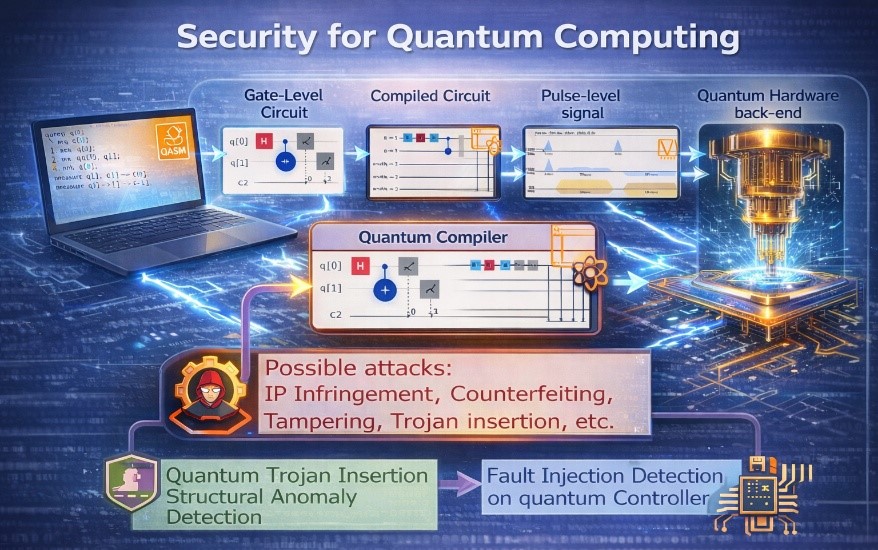
Quantum computing has become the future evolutionary computing features; we investigate quantum computing IP protections against untrusted compilers and circuit IP leakage. Our research proposes methods such as split compilation/obfuscation, enhanced locking mechanisms and quantum trojan detection, timing side-channel analysis for quantum computation to preserve functionality while making reverse engineering on quantum computing framework substantially harder.
High-Performance Post-quantum Crypto Implementations and Acceleration
Post quantum cryptography has emerged as a central direction for future cryptographic systems as quantum attacks transition from theoretical to practical threats. We design, integrate, and evaluate PQC algorithms within real world protocols and software stacks, focusing on end-to-end deployability. Our work emphasizes architecture aware optimization of PQC primitives, particularly compute intensive schemes, to achieve high performance on modern CPU, GPU, and accelerator platforms. We further study PQC enabled secure communication in protocol settings such as TLS and QUIC, along with systematic profiling and optimization for resource constrained embedded and IoT platforms.
Confidential Computing for Machine Learning
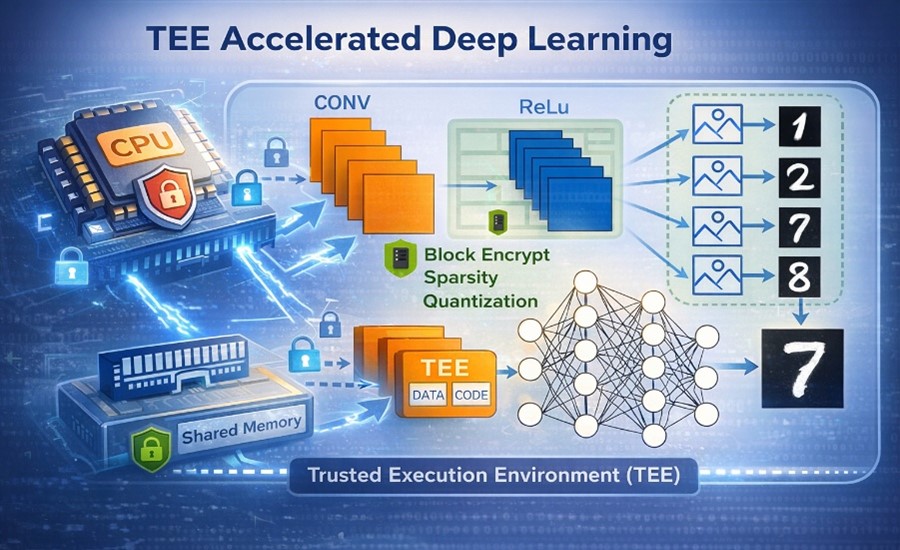
We investigate trusted execution environments and confidential computing as a practical security layer for sensitive workloads, such as circuit and SoC design flows that incorporate machine learning models and proprietary data. Leveraging modern machine learning architectures including transformers, large language models, and diffusion models, our goal is to ensure intellectual property protection even when computation is offloaded to shared or remote platforms.
This research is led by Dr. Qian Wang.
